Fitness Club Feasibility Study: What Owners Should Know Before Investing
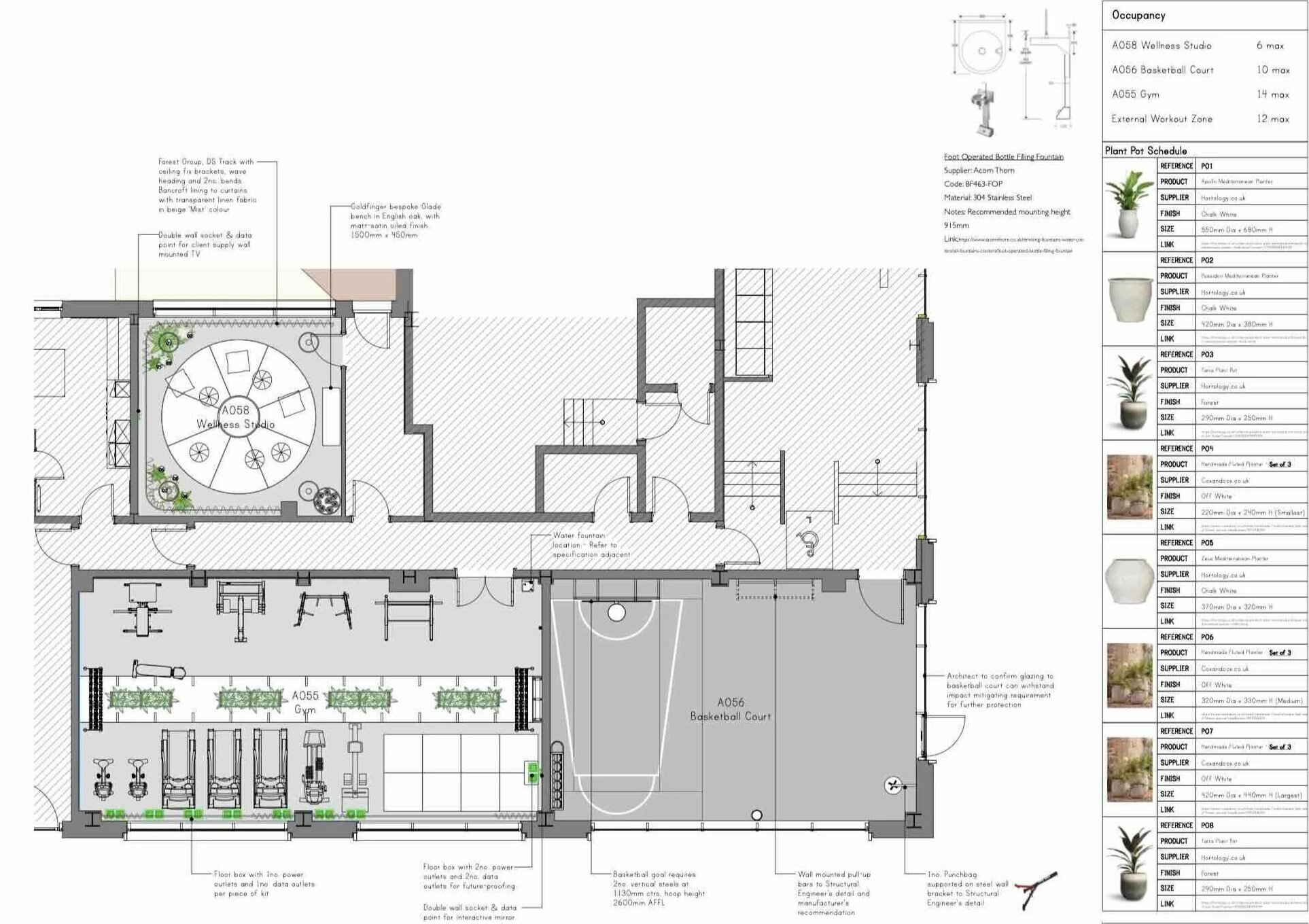
One part of our Technical Design pack for Fusion Students Nottingham
A surprising number of fitness projects begin too late in the process.
The building may already be secured. The owner may already have a strong instinct about the concept. Sometimes there is even an early layout or a shortlist of equipment suppliers. But the key commercial questions have not yet been tested properly.
Is there enough demand in the market?
What type of fitness club concept is actually viable?
Does the available space support the right business model?
And what should a fitness consultant assess before design work begins?
These are precisely the questions a fitness club feasibility study is supposed to answer.
At Biofit, we see this stage as part of a wider pre-design planning process. Before investing in architecture, interiors, fit-out or equipment, owners need to understand whether the proposed club makes sense commercially, spatially and operationally.
What is a fitness club feasibility study?
A fitness club feasibility study is an early-stage strategic review used to assess whether a proposed gym or fitness club concept is likely to succeed.
It should not be confused with full concept development, nor should it be limited to a financial spreadsheet. A good feasibility study sits between those extremes, living at the intersection of:
market demand
concept positioning
operating logic
space planning
financial assumptions
In other words, it helps an owner decide whether to proceed, refine the brief or stop the project before too much money has been spent.
This is why many owners engage a fitness consultant or gym consultant before appointing the full design team. A business analyst can do the numbers but not the concept. Many gym consultants can do the concept but not the numbers. We pride ourselves on bridging both worlds to provide a specialist service for would-be investors that gives them the peace of mind needed to invest in the subsequent work phases of concept development, interior design, equipment and technical specfication, followed by pre-opening advisory.
Why a gym feasibility study matters
Many fitness projects fail long before opening day, even if the interiors look good and the equipment package is strong.
The problem is often not design quality. It is that the underlying business case was weak from the start.
Common issues include:
overestimating local demand
targeting the wrong customer segment
assuming the market will support a premium offer when it will not
underestimating staffing and operational costs
forcing too many functions into too little space
relying on a concept that sounds attractive but lacks commercial depth
A gym feasibility study helps surface these risks early.
It allows owners, developers and investors to test whether the concept is grounded in reality before moving into the more expensive design and procurement stages.
What should a fitness consultant assess
A credible fitness consultant should look at much more than equipment count or membership pricing.
At pre-design stage, the review should usually cover five areas.
1. Market and demand
The first question is simple: is there a real market for the proposed club?
That means looking at:
local population and catchment
likely customer segments
seasonality, if relevant
existing competitors
price positioning across the market
gaps in the local offer
A fitness club consultant is not only asking whether people want a gym. The real question is whether the market wants this type of club, at this price point, in this location.
That is a more useful starting point.
2. Concept positioning
Not every market wants the same product.
Some locations may support a premium fitness club with recovery services and a strong design-led identity. Others may be better suited to a more accessible local gym with 24-hour access, simple staffing and a tighter cost base. Remaining neutral in stance at this early stage is therefore critical to success. Going in with a fixed idea and failing to flex around market realities is, in our view, a recipe for failure.
At this stage, the owner should be asking:
Who is the target member?
What is the core proposition of the new club?
Is this a gym, a fitness club, a health club or a broader wellness concept?
Is the offer premium, mid-market or value-led?
Will secondary services such as personal training, classes or recovery add real value?
This is one reason the language matters. A gym consultant may imply a narrower technical brief. A fitness consultant or fitness club consultant often suggests a broader role in shaping the concept itself.
3. Space planning and operational fit
This is where many projects become more complicated.
A site may look large enough on paper, but still not work operationally. Or the opposite may be true: a modest footprint can still support a strong concept if the space is planned intelligently.
At pre-design stage, the right exercise is usually a high-level test-fit.
This means checking:
whether the club can accommodate the required functions (a high-level space plan using a DWG file of the building will fix that)
whether circulation works (again, based on an initial space plan and zoning layout)
how much area should be allocated to training, reception, changing, storage and the all-important back-of-house (square feet allocations and overall % calculations help here)
whether the space supports the intended member capacity (this can then be mapped onto average membership fee to inform revenue projections but needs to be tempered by local market realities if it is to have any real significance)
whether specialist rooms such as studios, recovery zones or treatment rooms are realistic or pertinent for the chosen concept, space plan, location, target market, etc.
This is where pre-design planning becomes so important. Before a designer develops the interiors, a fitness facility planning exercise should confirm that the site can support the operating model.
4. Financial assumptions
Not every client needs a formal investment memorandum. But almost every owner needs a decision-useful business case.
That usually includes:
likely membership assumptions
joining fees, monthly pricing or seasonal models
personal training and ancillary revenue, where relevant
payroll assumptions
operating cost assumptions
simple scenario testing
a high-level view of feasibility over time
This is where the brief needs to be framed carefully. Some clients ask for a “multi-year proforma” when what they really need is a strategic commercial model to support a go / no-go decision.
That is a sensible scope for many early-stage projects and the way we typically work with our clients.
5. Go / no-go recommendation
A proper fitness club feasibility study should end with a recommendation from the consultant side.
That recommendation may be:
proceed (an opportunity has clearly been identified)
proceed, but refine the concept (modifications are needed, so this is where the client has to maintain an open-mind)
pause until further information is gathered (this may be an indefinite pause, or simply a time out)
do not proceed (no clear opportunity identified)
This all sounds obvious, but when millions of dollars or euros are at stake, it matters. Too many consultants deliver information without a clear commercial conclusion.
Owners need a point of view, and we are paid to provide one, backing it up with facts too.
When should you hire a gym consultant or fitness consultant?
The right time is usually before architecture and interior design are too far advanced.
A fitness consultant is often most valuable when:
a site has been identified but the concept is still fluid
a family office or private owner is exploring a possible fitness investment
a developer wants to test whether a fitness amenity or health club is viable
a hotel owner is considering a branded or independent fitness club offer
an operator wants to validate a new market or club format
a project brief exists, but the business case has not yet been pressure-tested
This stage sits naturally within pre-design planning services.
What a fitness club consultant should not promise too early
It is also important to define what a feasibility phase is NOT.
At early stage, a consultant should be careful not to overpromise:
detailed architectural design
full technical engineering input
formal lender-grade underwriting
detailed construction cost planning
full equipment specification before the concept is confirmed
Those elements may come later. But the feasibility stage should remain focused on concept validation, space logic and commercial sense-checking.
How Biofit approaches pre-design planning for fitness clubs
At Biofit, we see pre-design planning as the stage where the most important strategic decisions are made.
Before design development begins, we help clients assess:
whether the local market can support the proposed fitness club
what concept is most commercially relevant
whether the available site supports the right operational model
what level of capacity the space can realistically handle
what a high-level financial case might look like
In practical terms, this often combines:
market and competitor review
concept definition
space planning logic
capacity sense-checking
high-level financial feasibility
That gives the client a much stronger basis for deciding whether to move forward.
Final thought
A new gym or fitness club should not begin with equipment selection or moodboards.
It should begin with the harder questions:
Is there enough demand?
Is the concept right for the market?
Can the site support it properly?
And does the commercial case justify the investment?
That is the role of a fitness club feasibility study.
Whether you call it a gym feasibility study, fitness consultant brief, or pre-design planning exercise, the principle is the same: test the idea properly before committing to the next phase.
FAQ
What is the difference between a gym consultant and a fitness consultant?
In practice, the terms often overlap. “Fitness consultant” may suggest a broader strategic role covering concept, operations and feasibility, while “gym consultant” can sometimes sound more technical or facility-focused.
What is included in a fitness club feasibility study?
Typically: market review, competitor analysis, concept positioning, space planning logic, capacity testing and a high-level financial model.
Do I need a feasibility study before designing a gym?
In most cases, yes. It helps confirm whether the concept, location and space are commercially viable before design costs escalate.
Can a fitness consultant help with space planning?
Yes. At pre-design stage, this is often done through a high-level test-fit or capacity sense-check rather than full architectural design.
Is a fitness club feasibility study the same as a business plan?
Not exactly. A feasibility study tests viability and concept logic. A full business plan may go further into detailed operations, staffing, financing and implementation.
NEXT STEPS: INTERESTED IN DISCUSSING YOUR PROJECT WITH US?
EMAIL US HERE OR SEE HERE FOR OUR GYM + SPA CONSULTANT SERVICES