How to Implement Sustainability in a Wellness Club Without Compromising Design or Performance
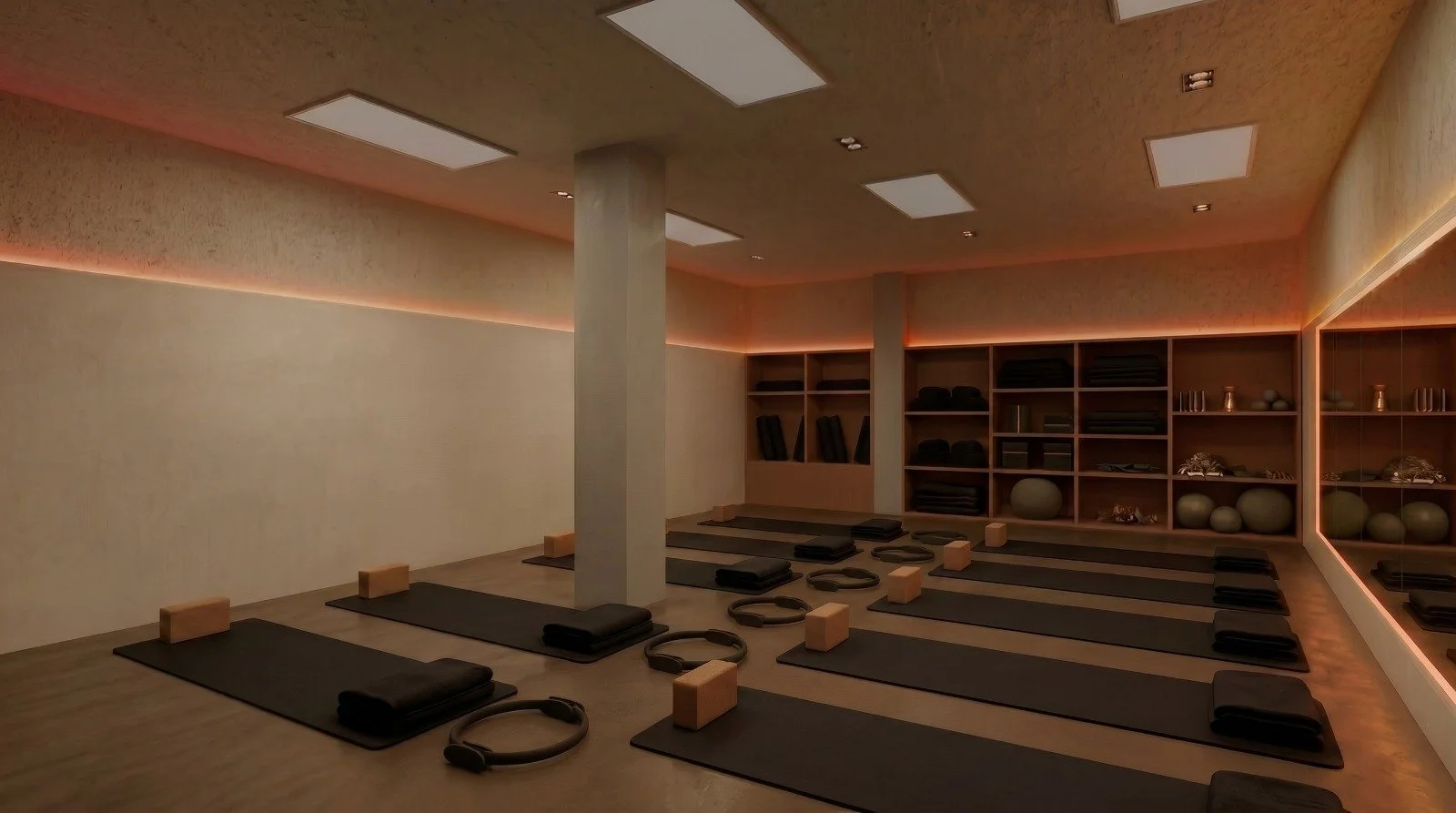
CRCLE wellness club heated group class studio, Marbella, Spain (design by Biofit for a private client)
We’ve been beating the ‘Sustainability In Gyms’ drum for many year now, so planet-friendly concerns continue to influence our designs for wellness clubs and social wellness clubs, representing the new wave of health club facilities effectively.
So if a club is being positioned around health, recovery and long-term wellbeing, surely the built environment (the interiors of the facility) should also reflect that in practical ways: healthier materials, lower-energy systems, more durable finishes, better water efficiency and a more considered procurement strategy? It seems a logical argument from our perspective.
The challenge, of course, is that real projects are shaped by budget pressure, value engineering and delivery constraints. Not every sustainability feature survives intact from concept development through schematic design and fit-out. But that is not a reason to ignore the subject. It is a reason to address it early, clearly and pragmatically.
At Biofit, we see sustainability in wellness spaces not as a separate “green layer,” but as part of the core design and fit-out strategy. The question is not simply how to make a club look more sustainable. The real question is how to make sustainability decisions that tangibly enhance the user experience and brand image of the project, without compromising performance, durability or commercial viability.
Start with the fit-out, not just the branding
A lot of wellness brands talk about health, nature and longevity, but the actual fit-out decisions often tell a different story. Cheap adhesives, high-VOC paints, poor-quality vinyls, overdesigned joinery and energy-hungry systems can quickly undermine a club’s stated values.
That is why the most useful sustainability measures are often the least glamorous. They sit in the background of the project, quietly making a difference, often without members even knowing they are in place.
the paint specification (non-toxic, lime or clay based)
the flooring choice (toxin-free rubber, recyclable vinyl tiles, cork tiles, ceramic tiles with upcycled content)
the lighting controls (to adjust to the time to day)
the plumbing fixtures (low flow)
the timber certification (FSC)
the procurement brief
the durability of the materials selected
These decisions may not be the most visible in a render, but they have a real impact on indoor air quality, maintenance cycles, operational costs and the long-term credibility of the project.
Healthy materials should come first
In a wellness club, the material palette matters for more than aesthetics.
People are training hard, breathing deeply, recovering, spending time barefoot and, in some cases, moving between gym, studio, spa and treatment areas in one visit. That makes healthy material choices especially important.
A good starting point is to prioritise:
low-VOC paints
low-toxicity adhesives and sealants
finishes with better indoor air quality performance
materials that do not off-gas aggressively after installation
robust surfaces that are easy to clean without harsh maintenance cycles
This is particularly relevant in studios, treatment rooms, recovery spaces and enclosed training environments where users spend meaningful time.
Sustainability in this context is not just about carbon or recycled content. It is also about creating interiors that feel healthier to occupy.
Flooring is one of the biggest opportunities
Flooring is often one of the largest material packages in a wellness club, and one of the most important from both a performance and sustainability perspective.
The wrong choice can create issues around odor, durability, indoor air quality and early replacement. The right choice can improve user comfort, acoustic performance and environmental credibility all at once.
At a minimum, it is worth asking:
does the flooring have an EPD?
is there recycled content where appropriate?
is the product durable enough for the actual use case?
will it age well in a high-traffic gym or studio environment?
does it support the acoustic and comfort needs of the space?
Not every zone needs the same answer. A functional gym floor, a movement studio, a spa circulation space and an outdoor social area will all have different requirements. But the sustainability conversation should begin at specification stage, not after the contractor has already priced the cheapest option.
Durability is part of sustainability
One of the biggest mistakes in wellness design is treating sustainability as a question of labels alone.
A material is not especially sustainable if it needs to be replaced quickly, performs badly under use or looks tired after a short period of time. In a wellness club, durability is not separate from sustainability. It is one of its most practical expressions.
That applies to:
gym flooring
lockers
joinery
sanitaryware
lighting
furniture
wall finishes
spa and wet-area surfaces
A club that is well designed but poorly specified will often become more wasteful over time. Materials fail, corners are cut, and the operator ends up replacing items sooner than expected. A more robust specification may cost more upfront, but it often creates a better long-term outcome both commercially and environmentally.
Lighting and controls are easy wins
Not every sustainability measure needs to be complicated.
In many projects, the most straightforward improvements come from:
high-efficiency LED lighting
occupancy or motion sensors in back-of-house and lower-traffic areas
sensible switching and zoning
dimming and scene control where appropriate
These are not radical ideas, but they are often missed or under-specified in smaller wellness projects.
Studios, changing areas, treatment rooms, WCs, storage areas and circulation zones all benefit from more thoughtful lighting control. The result is not only lower energy use, but often a more polished and operationally intelligent space.
Water efficiency should be addressed quietly but early
Water-saving measures rarely define the visual identity of a project, but they should still be part of the design conversation.
Low-flow taps, efficient shower fittings and robust plumbing fixtures are sensible measures in wellness clubs, especially where showers, treatment areas and spa support spaces are used regularly.
The key is to avoid the false choice between performance and efficiency. In most cases, the right products can support both, provided they are selected early enough and not treated as an afterthought during contractor procurement.
Procurement strategy matters more than many clients realise
A lot of sustainability value is lost not at concept stage, but at procurement stage.
This is where good intentions often disappear under budget pressure or vague substitution language. If the project team does not actively ask for environmental product documentation, FSC certification, VOC data or EPDs, those criteria tend to fall away quickly.
That is why procurement strategy matters.
Even a simple policy can help, such as:
giving preference to local or regional suppliers where viable
requesting environmental documentation during tender
asking contractors to state clearly when cost-saving substitutions reduce sustainability performance
reviewing key items not only on capital cost, but also on durability and maintenance logic
This does not require the project to become a certification exercise. It simply requires sustainability to remain visible during the decision-making process.
Outdoor furniture and exterior areas should not be ignored
Wellness clubs increasingly rely on terraces, outdoor training zones and social exterior spaces to strengthen their offer. These areas should be included in the sustainability conversation too.
A sensible approach may include:
FSC-certified timber where timber is used
durable outdoor materials suited to the local climate
furniture that can be maintained rather than quickly replaced
planting strategies that support the arrival experience without becoming high-maintenance theatre
In climates such as southern Spain, durability and local suitability matter just as much as the sustainability label itself. A beautiful outdoor furniture package that degrades too quickly is not a sustainable outcome.
Some measures are worth recording even if they do not survive budget review
This is an important point.
Not every project will implement every sustainable measure in full. But there is still value in issuing a sustainability recommendations note at handover or fit-out stage so that those options are actively considered, not simply forgotten.
This might include items such as:
IAQ monitoring
better filtration standards
air purifiers in selected zones
biophilic planting
more advanced lighting logic
stronger healthy-material substitutions
Some will make it through. Some will not. But formally recording them is still worthwhile, especially if the client later revisits upgrades after opening.
A practical sustainability strategy is better than a performative one
The best sustainability measures in a wellness club are rarely the loudest.
They sit in the details of the fit-out and procurement process. They improve how the club feels, how long it lasts and how credibly it aligns with the values it wants to project.
For developers, operators and founders, the goal should not be perfection. It should be sensible implementation: choosing the sustainability measures that genuinely improve the project and protecting them where possible as pricing and procurement evolve.
That is where specialist design support becomes useful. The role is not only to generate a concept, but to help the project team understand which choices are worth defending as the club moves from design into delivery.
Need help integrating sustainability into a wellness club project?
If you are planning a gym, wellness club, studio or recovery concept and want to bring sustainability into the fit-out and procurement process in a realistic way, Biofit can help shape the strategy from concept through to implementation support.
This article was written by Matt Morley, an IWBI WELL Building Advisor for 2026 (Mind category).