Acoustic Design for Wellness Clubs | Wall Thicknesses, Privacy & Noise Control
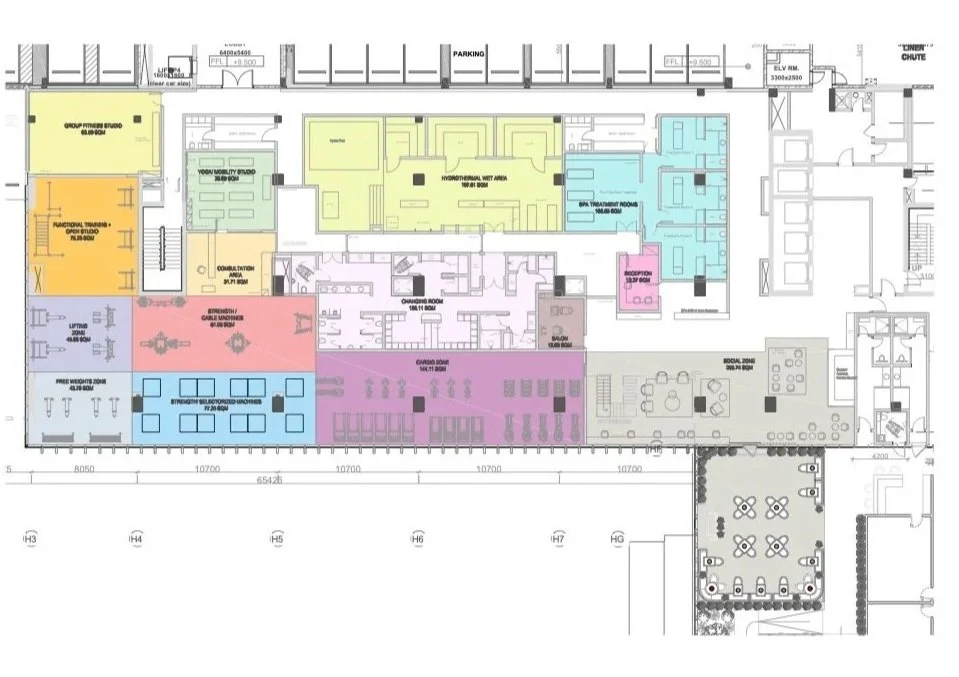
example of a wellness club zoning map, used to open a discussion about functional adjacencies and noise transfer between zones
Acoustic comfort is one of the most overlooked aspects of wellness club design, yet it has a direct impact on how premium a space feels.
A treatment room that carries voices from the corridor, a changing room full of echo, or a movement studio leaking music into a spa area can quickly undermine the user experience. In a well-designed wellness club, acoustics should support privacy, calm, focus and recovery.
For developers, operators and architects, this is not just a technical issue. It is part of the wider design strategy, alongside layout planning, lighting, flooring and material selection.
At Biofit, this question often arises as projects move from concept or schematic design into detailed design: is a 20 cm wall enough, or do some spaces justify 25 cm partitions? And when trying to improve acoustic comfort, is it more effective to focus on ceilings or walls?
The answer depends on the relationship between spaces, the intensity of activity, the services within the partition, and the level of privacy the guest is expected to experience.
Why acoustics matter in wellness club design
Most wellness club designs combine very different types of spaces under one roof. Some are active and social, such as gyms, movement studios and reception areas. Others are quieter and more private, such as treatment rooms, changing rooms, thermal areas and relaxation zones.
That mix creates acoustic tension if it is not carefully managed from the outset.
Typical issues include:
music and bass transfer from training or studio areas
speech transmission between treatment rooms
reverberation in changing rooms with hard finishes
plumbing and mechanical noise in wet areas
sound leakage through doors, glazing and service penetrations
This is why acoustic thinking should be addressed early in the design process, rather than treated as a late-stage fix.
Is a 20 cm wall thick enough?
In many cases, yes.
A 200 mm wall can be sufficient for most perimeter partitions in wellness clubs, including treatment rooms, changing rooms, spa rooms and movement spaces, provided the wall build-up is properly specified.
What matters is not just the thickness on plan, but how the wall is constructed. A well-performing 200 mm partition may include:
robust stud framing
dense mineral wool acoustic insulation
multiple layers of board where needed
cementitious board in wet areas
careful sealing at all junctions
properly coordinated service penetrations
In practice, a well-designed 200 mm wall will often perform better than a poorly detailed 250 mm wall.
When should walls increase to 25 cm?
There are definitely cases where 250 mm is justified, but not everywhere.
It is usually worth considering thicker walls where the acoustic and technical demands are greater, for example:
movement studios next to treatment rooms
gym areas beside spa relaxation spaces
wet walls carrying substantial plumbing or controls
hammams, steam rooms and thermal areas
high-end treatment rooms where privacy is central to the guest experience
In these situations, the extra depth can help with both acoustic separation and services integration.
For most projects, a tiered approach works best:
150 mm for back-of-house, office and low-sensitivity internal walls
200 mm for most treatment, changing, spa and studio partitions
250 mm for selected high-performance walls between noisy and quiet spaces, or where services are heavier
That usually gives the best balance between space efficiency, cost control and user comfort.
Wall thickness is only part of the picture
One of the most common mistakes in wellness and fitness design is to focus only on wall thickness.
In reality, the weakest acoustic points are often elsewhere, including:
doors and door undercuts
glazing
unsealed service penetrations
shared ceiling voids
back-to-back electrical boxes
ductwork and mechanical transfers
poorly detailed wall-to-slab junctions
So even where the wall build-up is sound, poor detailing elsewhere can compromise the result.
Acoustic panels: ceiling or wall?
This depends on what you are trying to solve.
In general, acoustic ceilings are more effective for reducing reverberation within a room. They help control echo, soften the sound environment and improve comfort in spaces with many hard finishes.
They are often especially useful in:
movement studios
changing rooms
reception and lounge areas
consultation rooms
circulation spaces
Ceilings are often the most efficient first move because they provide a large uninterrupted surface area for sound absorption.
By contrast, wall acoustic treatment is often more targeted. It can help reduce reflections, soften the character of a room and improve comfort where ceilings are crowded with services or where more absorption is needed locally.
Wall treatment can work well in:
treatment rooms
consultation rooms
relaxation spaces
studios with hard perimeter finishes
In more premium projects, this can be integrated discreetly through upholstered panels, slatted timber systems with acoustic backing, or other decorative wall treatments.
In practice, ceilings and walls do different jobs
A useful way to think about it is:
partition build-up controls sound isolation between rooms
acoustic ceilings reduce echo and reverberation within a room
wall acoustic panels fine-tune comfort and reflection in key areas
The best results usually come from combining these strategies rather than relying too heavily on just one.
Acoustic priorities by area
Treatment rooms
These generally require the highest level of speech privacy. High-quality partitions, doors, seals and selective absorption all matter here.
Spa and thermal areas
These spaces often combine hard finishes, mechanical services and wet construction. Acoustic control needs to be coordinated with waterproofing and technical systems.
Changing rooms
Changing rooms can become noisy very quickly due to lockers, mirrors, tiled finishes and high occupancy. Acoustic ceilings are often one of the most effective upgrades.
Movement studios
These spaces generate amplified music, instructor voice projection and impact noise. If positioned next to quieter uses, stronger wall build-ups and more careful zoning are important.
Reception and lounge areas
These spaces should feel lively but controlled. Ceiling absorption, softer materials and loose furniture all help reduce harshness.
Typical issues include:
music and bass transfer from training or studio areas
speech transmission between treatment rooms
reverberation in changing rooms with hard finishes
plumbing and mechanical noise in wet areas
sound leakage through doors, glazing and service penetrations
Common mistakes in wellness acoustic design
A few issues appear repeatedly:
using standard partitions between acoustically sensitive spaces
underestimating the impact of doors and glazing
specifying hard surfaces everywhere without adding absorption
forgetting about flanking sound paths through ceiling voids
placing movement studios next to treatment rooms without upgraded separation
focusing on products, but not installation detailing
In many projects, the real issue is not the wall thickness itself, but the way the whole assembly is coordinated.
Practical guidance for architects and developers
For most wellness club projects, a sensible starting point is:
use 200 mm as the default for key guest-facing partitions
use 250 mm selectively between active and quiet spaces, or where services are heavier
use 150 mm for lower-risk back-of-house and secondary partitions
prioritise acoustic ceilings in studios, changing rooms and reception-type spaces
add targeted wall absorption in treatment rooms and quiet zones where needed
pay close attention to doors, penetrations and ceiling interfaces
This keeps the strategy proportionate, without over-engineering every wall.
Acoustic comfort supports the premium experience
In wellness design, acoustics are not simply about compliance. They shape how a space feels.
A quieter treatment room feels more private. A calmer changing room feels more considered. A movement studio with controlled reverberation feels more professional. These qualities all influence the guest experience and the commercial positioning of the club.
For developers and operators investing in premium wellness environments, getting the acoustic strategy right early can prevent costly revisions later and help deliver a more refined final result.
Planning a wellness club or fitness space?
Biofit advises developers, operators and design teams on the planning and design of gyms, wellness clubs, movement studios and spa-integrated fitness environments. From concept development and layout planning through to equipment strategy and design coordination, we help create spaces that perform operationally and feel exceptional to use.
FREQUENTLY ASKED QUESTIONS
-
Often yes, provided the wall build-up, insulation, door specification and sealing are properly designed.
-
Ceilings are often the most effective first step for reducing reverberation, while wall treatments can be added where more targeted absorption is needed.
-
Sometimes. If they sit beside quieter spaces such as treatment rooms or spa areas, upgraded partitions may be justified.
-
Not just wall thickness. Doors, glazing, penetrations, ceiling voids and detailing often have an equally important impact.