Designing Bespoke Fitness Concepts for Hotels and Resorts
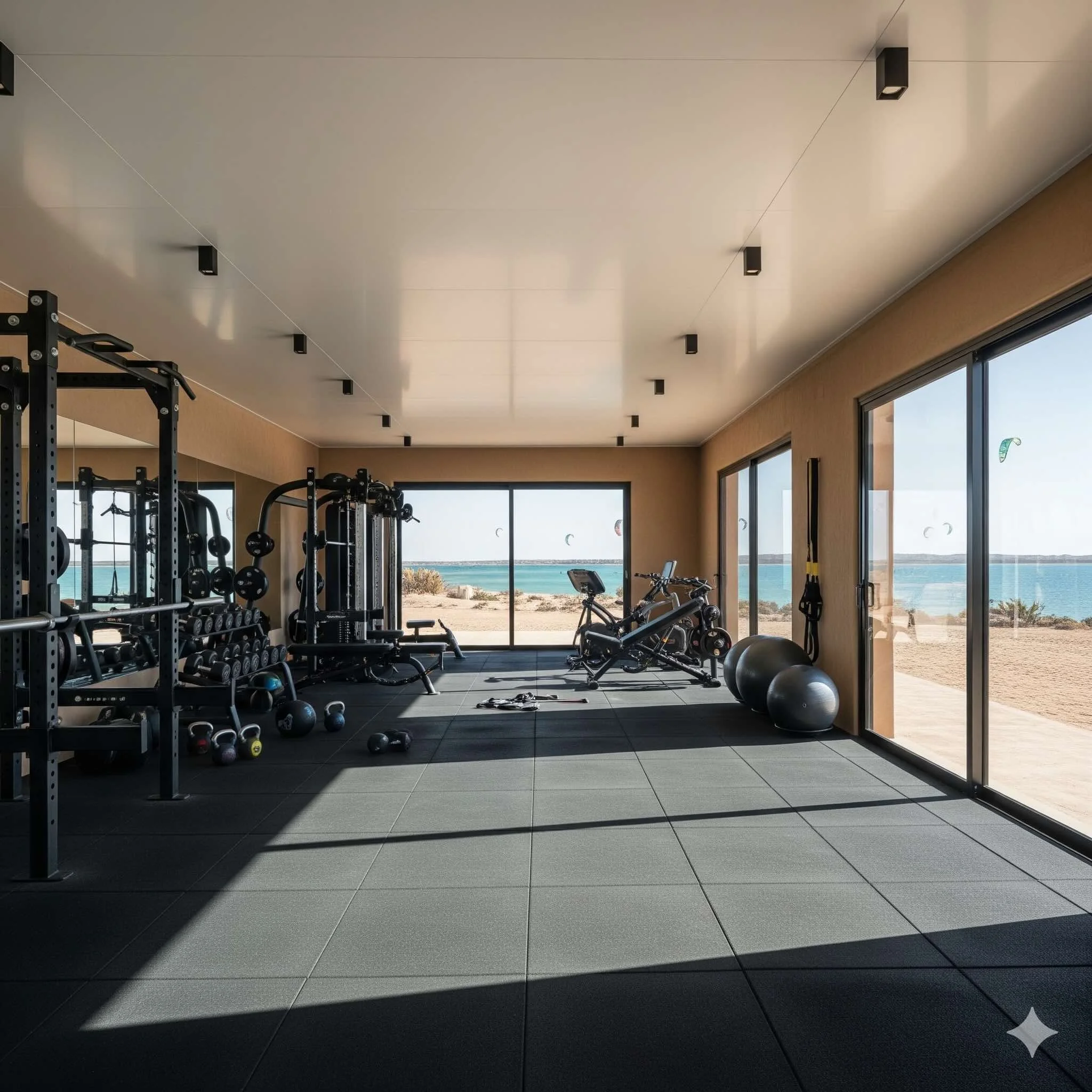
a Biofit concept design for a surf-inspired beach resort
How Biofit designs gym and wellness spaces around brand, guest profiles, and destination lifestyle
A hotel gym should never be an afterthought — but it also shouldn’t be a generic “machine room” copied from a supplier catalogue.
The most successful hospitality fitness spaces feel inevitable: they reflect the hotel brand, the guest mix, and the destination lifestyle. In surf and kitesurf destinations, that means fitness and recovery are part of the experience, not a bolt-on amenity.
Biofit specialises in concept-specific fitness and wellness spaces for hotels and resorts — from brand-led gym concepts through to equipment specification and site-specific layouts. This article explains the framework we use to deliver premium, hard-wearing, guest-aligned fitness environments across multiple properties and diverse destinations.
Why “generic hotel gyms” underperform
Hotels are increasingly judged on lifestyle alignment. When your brand narrative is wellness, surf, kite, outdoor adventure, longevity, or design-led hospitality, a generic gym creates three predictable problems:
It doesn’t match the guest’s intent
Resort guests train differently from city-hotel guests: warm-ups, mobility, short functional circuits, and recovery routines often take priority over long machine workouts.It isn’t inclusive
A good resort gym must work for confident gym users and occasional guests. If it feels intimidating or confusing, it will be underused.It doesn’t survive operational reality
Hospitality gyms must withstand high turnover and imperfect user behaviour. In coastal destinations, add sand, salt, and humidity — which changes everything about finishes, storage discipline, and maintenance.
Biofit’s approach: brand-led fitness concepts, not equipment shopping lists
The core principle is simple: the concept comes first. Equipment, zoning, and finishes follow from a clear point of view.
The four inputs we align early
A strong resort fitness concept is anchored in four variables:
Hotel brand positioning
Luxury eco-lodge, design hotel, wellness resort, surf retreat, adventure lodge, etc.Guest profiles
Core users, beginners, companions, families, mixed groups, and how they share the space.Site realities
Space constraints, geometry, ceiling heights, ventilation strategy, circulation, natural light, and (critically) local environment conditions.Owner preferences
Capex priorities, tolerance for maintenance, procurement constraints, and what “premium” means for that brand.
This framework is particularly effective for multi-site brands, where you want a consistent standard that can be applied across properties while adapting to local constraints.
Step 1: Define guest personas and usage scenarios
In hospitality, “the user” is never one person. A resort gym typically serves multiple segments simultaneously — especially in surf/kite destinations.
A reliable starting set of personas includes:
The performance-led core guest (training as support for sport)
The active improver (building capacity and confidence)
The wellness-first occasional user (mobility + light cardio)
The tag-along partner (efficient, non-technical workouts)
Family / mixed-group users (safe, flexible, shared usage)
Output: a persona matrix that translates into design decisions: zoning priorities, guidance level, storage requirements, and durability assumptions.
Key insight: mobility and “free floor space” are not optional in a resort gym — they are central to both performance support and beginner friendliness.
Step 2: Benchmark the right references — then decide what to borrow
Benchmarking should focus on typologies, not copying. For surf and kitesurf audiences, we typically evaluate:
Surf/kite resorts where fitness supports time outdoors (not the headline)
Design-led boutique hotels where the gym feels premium with minimal kit
Eco-lodges and coastal properties where durability and maintenance are central
Operator-led “performance cultures” that reveal what committed athletes expect
Output: a benchmark board plus a simple positioning map (two axes) that clarifies where your property should sit — for example:
Boutique design vs camp utility, and
Lifestyle simplicity vs performance support
This keeps the concept coherent and prevents the gym from drifting into either “too utilitarian” or “too generic hotel.”
Step 3: Create the base module — zoning, capacity, and station planning
One of the most practical planning tools is a repeatable gym module. For many resorts, the sweet spot is a well-designed 50–75 m² gym that feels premium and works for mixed groups.
Instead of starting with equipment counts, we plan around:
Zones: strength/functional, cardio, mobility/prep, storage/housekeeping
Stations: how many people can train at once without queues
Flow: a clear circulation spine and intuitive self-guided use
Station logic (what “works” operationally)
A useful rule of thumb is to plan enough stations to avoid queues at comfortable occupancy, while still tolerating short peak periods (e.g., poor surf or low wind days).
Examples of station planning for a 50–75 m² module:
50 m²: 2 cardio + 2–3 strength + 2 mobility slots
75 m²: 3 cardio + 4 strength + 3–4 mobility slots
This keeps the room usable for parallel activities: someone warming up, someone lifting, someone doing mobility, and someone doing a self-guided circuit — without creating conflict.
Capacity guidance (what you can claim early)
Capacity is easier to communicate as:
Comfortable capacity: a premium guest experience
Peak capacity: workable for short periods, but busier
A sensible early guideline:
50 m²: comfortable 6 users / peak 8 users
75 m²: comfortable 9 users / peak 12 users
Your exact numbers will tighten once the room geometry is confirmed, but setting a capacity target early prevents over-equipping and protects the guest experience.
Step 4: Build a kit-of-parts schedule (and eliminate “filler pieces”)
A well-designed resort gym is usually curated, not over-equipped.
Biofit’s kit-of-parts approach prioritises:
high-utility functional training tools
a credible strength anchor (scaled to room size)
a compact cardio set aligned to guest behaviour
a recovery/mobility toolkit treated as core equipment
storage and housekeeping elements that protect the premium feel
The equipment schedule is structured by zone (Strength / Cardio / Mobility / Operations) so it remains usable for owners, operators, and architects — and can be adapted to local product availability and service realities.
Step 5: Provide architect notes that protect the end result
Even when Biofit’s scope is concept + equipment strategy, we provide high-level but actionable interior notes for local architects. This safeguards quality without turning the concept phase into a full interior design package.
Typical “architect notes” that materially improve outcome:
Rubber gym flooring strategy (durable, cleanable, appropriate underlay)
Robust wall-base / skirting and protection details in high-wear zones
Mirror strategy and lighting scenes (day/evening/cleaning)
Power + data readiness for cardio zones (floor boxes or perimeter sockets)
Optional impact wall logic for functional training (nice-to-have)
Coastal durability (corrosion-resistant fixings, wipeable finishes)
Ventilation and humidity control to protect equipment and finishes
Closed storage discipline to keep the room calm, premium, and usable
These notes reduce downstream friction, prevent common mistakes, and help local teams deliver a gym that still feels “brand-right” after value engineering.
Where lifestyle hotel brands win with fitness (e.g., design hotels)
Lifestyle brands succeed when the gym feels like an extension of the brand universe — not a compliance amenity.
For design-led hotel groups, that usually means:
Curation over quantity: fewer pieces, better selection, more space to move
Aesthetic coherence: lighting, mirrors, materials and storage treated as part of the guest experience
A “studio mindset”: space for mobility, functional circuits, and short sessions that fit a travel schedule
Brand voice + rituals: simple guidance such as “10-minute reset” or “pre-surf warm-up” that makes the gym feel hosted even when self-guided
This is especially relevant in surf destinations (e.g., Portugal’s surf coast), where guests follow the rhythm of the ocean — early surf, midday recovery, evening movement — and the gym becomes a flexible support space rather than the main event.
Why surf and watersports destinations are the clearest case for concept-specific gyms
Surf and kitesurf destinations make the “concept-first” approach obvious because guests have repeatable needs:
warm-up and shoulder/hip resilience
posterior chain strength and trunk stability
mobility, stretching, and recovery routines
efficient workouts between outdoor sessions
flexible usage patterns when conditions change
Biofit is currently delivering this type of work for a luxury eco-lodge brand in Dakhla (Morocco), and we are also in discussions with other surf-led hospitality projects — including Portugal’s surf coast. The lesson is consistent: the gym must feel like a natural extension of the guest experience, not a standard hotel add-on.
How Biofit can help
Biofit supports hotels and resorts with:
Package 1 — Phase 1: Brand Fitness Concept & Equipment Standard
Best for hotel brands and resort operators who want a repeatable standard that can be rolled out across multiple properties (or applied consistently across multiple rooms / villas / sites).
Outputs typically include:
Guest persona typologies + usage scenarios
Benchmark typologies + positioning map
A base module plan (commonly 50–75 m²) with zoning ratios and capacity logic
“Kit-of-parts” equipment schedule (curated by category, with alternates based on availability and maintenance tolerance)
Architect notes (flooring, mirrors, lighting, power/data readiness, durability)
Result: a clear concept that aligns stakeholders early and prevents “catalogue gym” outcomes.
Package 2 — Phase 2: Site-Specific Layout & Technical Coordination
Best once the architect can issue a GA plan and key constraints (structure/MEP) are known.
Outputs typically include:
To-scale equipment layout with clearances checked
Site-specific equipment quantities and final selections
Technical coordination notes for the design team (flooring zoning, mirror locations, power/data points, circulation)
One review workshop + a light revision round
Result: the concept becomes buildable — without forcing expensive redesign later.
If you are developing a resort gym in a surf- or watersports-led destination — or standardising fitness across multiple properties — Biofit can help you define a guest-aligned, durable, design-coherent fitness concept that performs operationally and differentiates your brand.
FREQUENTLY ASKED QUESTIONS
-
For many boutique hotels and resorts, a well-designed 75–150 m² gym is the sweet spot.
It is large enough to support mixed usage (cardio, strength, mobility) without feeling cramped, but small enough to keep capex and maintenance under control. As a planning benchmark:
75 m² typically supports ~9 users comfortably (peak ~12)
Final capacity depends on room geometry, circulation, ceiling height constraints, and how “functional” versus “machine-based” the concept is.
-
A small resort gym performs best when it is curated. The essentials usually include:
Strength + functional: a credible “anchor” station (rack or cable station), adjustable bench, curated dumbbells and kettlebells
Cardio: 2–3 high-utility pieces (chosen for guest profile and maintenance tolerance)
Mobility/recovery: mats, bands, rollers, mobility balls, and space to move
Operations: closed storage, cleaning point, and simple etiquette signage
The goal is not “more equipment,” but enough stations to avoid queues and a layout that supports self-guided use.
-
Design around the reality that guests are training to support time outdoors. That typically means:
A strong mobility / prep component (shoulders, hips, posterior chain)
Functional strength over machine lines (pulling patterns, hinge patterns, trunk stability)
Compact cardio for warm-ups and “conditions-change” days
Clear space for movement, warm-up flow, and recovery routines
The gym should feel like a performance-support space while remaining welcoming to beginners and non-surfing companions.
-
Coastal gyms need specification that tolerates sand, salt, humidity, and frequent cleaning. Typically:
Flooring: gym-specific rubber (often rolls) with appropriate underlay and robust detailing at edges
Walls: wipeable, scuff-resistant finishes in high-wear areas; consider a protective wall base/wainscot
Hardware: corrosion-resistant fixings and door furniture; avoid untreated steel and chrome-heavy finishes
Storage: closed storage reduces clutter, protects equipment, and keeps the room premium
Also plan for ventilation and humidity management early to protect both equipment and finishes.
-
Start with brand + guest profiles, not equipment catalogues. Then:
Curate a “few but right” kit selection aligned to the destination lifestyle
Make mobility and movement space visible and intentional
Use layered lighting and considered mirrors to elevate the room
Integrate storage, cleaning points, and signage so the space stays calm and premium
Add simple brand rituals (e.g., “pre-surf warm-up” or “10-minute reset”) so the gym feels hosted even when self-guided