How to Design a Treatment Room for Future Clinical or Nurse-Led Wellness Use
We currently see requests from private clients designing their dream homes as well as entrepreneurs setting up a commercial wellness club asking for clinical use ready treatment rooms. Based on what we are seeing in the market right now as gym designers and spa designers, there is a fundamental shift happening that sees medical treatments creeping into wellness facilities.
Our clients are no longer thinking only in terms of massage rooms or facials. Increasingly, they want rooms that can support a broader longevity and recovery offer, including the possibility of IV drips, peptides, blood draws or other nurse-assisted wellness services in the future.
That shift has clear implications for us in terms of pre-design planning and concept development, as well as interior design.
A treatment room intended for possible clinical use cannot be designed like a standard spa room with a few upgrades added later. It needs a different approach to materials, detailing, storage, hygiene and lighting from the start.
At Biofit, we see this as part of the wider evolution of wellness spaces: interiors that sit between hospitality, health and performance, and need to work operationally as well as aesthetically.
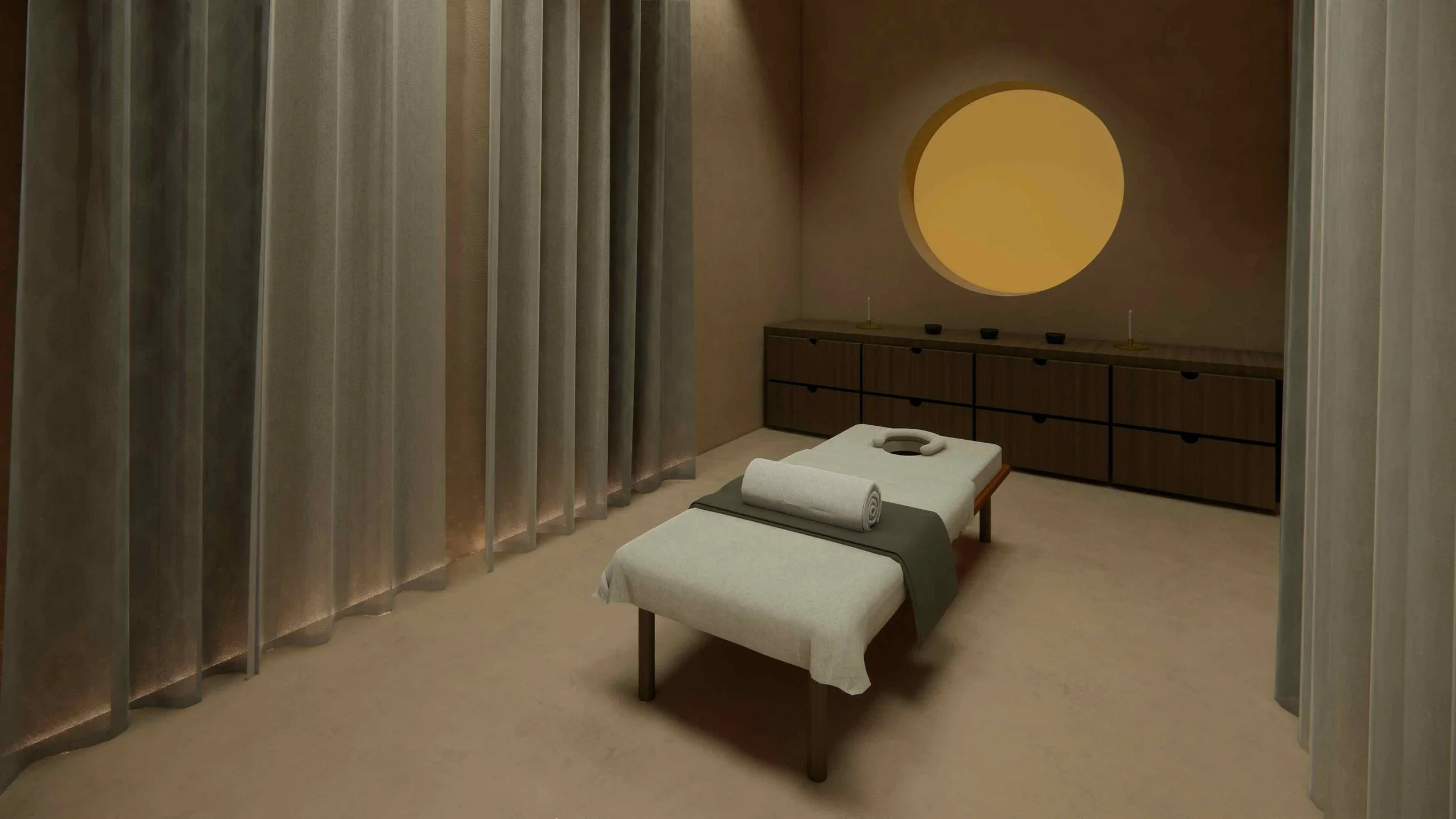
spa treatment room concept design for CRCLE Wellness Marbella by Biofit
The design challenge
The aim is not to create a hospital room inside a wellness club. That is usually the wrong visual language and often the wrong level of intensity for the client brief.
The aim is to create a clinical-capable treatment room: a room that still feels calm, premium and aligned with the wider wellness concept, but is materially and functionally better suited to a more hygienic, nurse-led or technical use if needed later.
That shift sounds subtle, but it changes many design decisions.
Cleanability becomes a core design principle
In a standard spa room, designers often prioritise softness, atmosphere and decorative layering. In a clinical-capable room, the priority moves toward surfaces that are easier to clean, more durable and less likely to trap dust or contamination.
That does not mean the room must feel cold or harsh. It means it should be designed with more discipline.
A better specification usually includes:
smooth, durable floor finishes
low-porosity surfaces
washable wall finishes
less decorative clutter
fewer absorbent materials
simpler detailing overall
This is where wellness design starts to overlap with healthcare thinking.
The floor and skirting detail matter a lot
One of the most important changes is at floor level.
If a treatment room may later support IV drips, blood draws or other nurse-led procedures, the floor-wall junction needs to be easier to clean than in a normal spa room. This often points toward more hygienic detailing, such as a coved skirting or another approach that removes sharp dusty corners and reduces dirt traps.
This is not a glamorous design topic, but it is one of the clearest examples of how a room shifts from spa aesthetic toward clinical-capable performance.
A functional sink should be part of the room
A treatment room with future clinical use in mind should include a proper sink within the room itself, integrated as a practical hygiene station rather than treated as a decorative vanity.
That changes both the layout and the materials around it.
The sink zone should feel:
easy to use
easy to clean
visually integrated
durable over time
It should support real use, not simply complete the look of the room.
Joinery needs to be calmer and more controlled
Many spa interiors rely heavily on open shelving, decorative accessories and visible display elements. In a clinical-capable treatment room, this can quickly become impractical.
The joinery should usually move toward:
more closed storage
simpler frontals
easier-to-clean surfaces
fewer ornamental details
a clearer separation between visual design and practical storage
If the room is expected to feel premium, that premium quality should come from restraint, material quality and composure rather than styling.
Furniture should look more professional
The furniture in a clinical-capable treatment room should still sit comfortably within the wellness brand, but it often needs a more technical reading.
That may affect:
the treatment bed or couch
stools and side chairs
trolleys or support surfaces
worktops and side counters
The room does not need to look like a clinic, but it should not rely entirely on soft, decorative spa furniture either. The design should suggest competence, cleanliness and adaptability.
Lighting should support both calm and task function
This is another area where spa design often needs to evolve.
A room intended for possible nurse-led use needs lighting that can support more precise work when required. That usually means layering the lighting more carefully so the space can operate in two modes:
calm and ambient for standard treatment use
brighter and more functional when needed
This is a much better solution than choosing one extreme or the other.
Layout matters more than many clients expect
If a room may one day support more technical use, it needs enough space to function properly around the treatment bed. Clearance, access, sink location, worktop position and storage all need to be resolved more carefully.
This does not necessarily require a much bigger room. It does require a more thoughtful layout.
The question becomes: can the room support a more operational way of working without feeling cramped or improvised?
Wellness design is becoming more specialised
This is part of a much larger trend. Wellness clubs, spas and hospitality projects are increasingly combining:
movement
recovery
treatment
diagnostics
social wellness
longevity-focused services
As a result, the treatment room is becoming a more specialised design problem. It needs to sit comfortably between spa, clinic and premium hospitality.
That is a difficult balance to get right. Too soft, and the room becomes operationally weak. Too clinical, and it loses the aspirational, brand-aligned feel that makes wellness spaces attractive in the first place.
The answer is usually not more decoration. It is better design judgement.
Designing for future flexibility
One of the smartest moves a client can make is to design a treatment room with future flexibility in mind, even if all services are not delivered from day one.
That does not mean over-specifying the room unnecessarily. It means making more deliberate choices around:
flooring
skirting detail
surfaces
sink provision
storage
lighting
layout
furniture selection
These decisions create a room that can evolve more easily alongside the operator’s wellness offer.
Biofit’s approach
At Biofit, we work on gyms, spas, studios, recovery spaces and treatment environments that need to perform well operationally while still supporting a strong visual and commercial concept.
That includes exactly these hybrid room types: spaces that are no longer purely leisure, but not fully medical either.
If you are planning a wellness club, longevity space, hotel spa or recovery concept and want to future-proof your treatment rooms, that is a conversation worth having early.
Need help planning treatment rooms within a wellness concept?
Biofit can help shape treatment room design, material strategy, layout and integration within wider wellness club, spa or longevity projects. CONTACT US VIA EMAIL HERE